
Why Choose Hydraulic Hose Fitting Manufacturers in China?





Choosing a hydraulic hose fittings manufacturer involves more than comparing unit prices. Buyers need to verify connection compatibility, material specifications, manufacturing controls and the supplier’s ability to meet repeat-order requirements. For a company considering China-based production, the question is whether the total sourcing cost and the supply model fit the application — not simply whether the quoted price is lower.
That question does not change when the plant is in China. The commercial model behind it does. Minimum quantities, tooling, order consolidation, inspection and the ocean leg all move, and each one changes what the part actually costs by the time it is in your rack. This page deals with those mechanics: what sourcing from China changes, what it does not, and which purchases are better placed elsewhere.
Table of Contents
- Why Source Hydraulic Hose Fittings from China?
- Where Chinese Sourcing Is the Wrong Answer
- Hydraulic Hose Fitting Compatibility: What Buyers Must Confirm
- Manufacturing Capabilities That Affect Fitting Quality
- How to Evaluate Cost, MOQ and Lead Time
- Why Consider HGW as a Hydraulic Hose Fittings Manufacturer?
- Request a Quote for Hydraulic Hose Fittings
Why Source Hydraulic Hose Fittings from China?
Start with what does not explain the price difference. A hose fitting is bar stock, machine time and plating, and none of the three is unique to one country. What differs is how each is bought, and how much of the cost sits outside the machine: programming, tooling, inspection, packing, freight and inventory. On a standard straight fitting bought in steady volume, the delivered cost gap may be narrower than the quoted price gap.
What China does change is the economics of a fragmented order. Ningbo and Yuyao, in Zhejiang, are among the areas where hydraulic fittings, ferrules, adapters, flange halves and quick couplers are produced alongside the plating lines, tool shops and gauge suppliers that support them. The consequence is not a lower price per piece. It is that several part numbers across several thread families, in two finishes, can be quoted as one job, plated in one batch and shipped under one document set. Where those processes sit days apart instead of hours, the same order becomes several lead times, several minimum batches and several sets of paperwork — and a hydraulic hose fittings supplier that cannot consolidate hands that fragmentation back to you as inventory.
For fittings produced from bar stock by turning, customization can be relatively straightforward. A non-standard hex, a longer neck or a different marking may require changes to programming, tooling or fixturing rather than a dedicated casting pattern. The actual cost and feasibility depend on the part design and the manufacturing route, so drawing review, sampling and first-article requirements should be quoted separately rather than assumed into the unit price. The sequence for specifying one is set out in the custom hydraulic fittings guide.
Lead time is the third difference, and it is easy to describe badly. Chinese supply is not automatically faster; on a first order it is often slower, because tooling, a sample and a first article come before production. What it offers is a schedule that can be planned around a sailing date, with a buffer you choose rather than a local stock position you inherit.
Where Chinese Sourcing Is the Wrong Answer
The limits are specific, and structural: each decides whether the supply model fits before the part is discussed.
- Brand-approved components. Where a drawing, a warranty or a classification rule names a maker and a part number, substituting equivalent geometry is a decision for whoever granted the approval — not for the buyer and not for the new supplier.
- Weekly replenishment. If a line needs stock in five days, an ocean shipment cannot serve it. Offshore supply runs on a schedule, not on demand, and a local distributor earns its margin on exactly that gap.
- Very small quantities. Fittings are dense. Below a certain order value, freight, inspection and paperwork cost more per piece than the unit price difference, whatever the country.
- Assemblies under a hose maker’s crimp approval. Where the hose manufacturer certifies a specific insert, ferrule and crimp combination, a dimensionally identical ferrule from an unapproved source is not the same part in the eyes of that approval.
- Qualification cost above the saving. If the part needs a formal submission package, a destructive test program or a per-drawing second-source approval, engineering time can exceed the price difference on a low-volume line.
Hydraulic Hose Fitting Compatibility: What Buyers Must Confirm
The expensive mistake here is not choosing the wrong country. It is approving a fitting because the thread engages, when the connection as a whole was never checked.
The sealing mechanism depends on the connection design. Some fittings seal through tapered thread engagement, while others rely on a cone, a flare, an O-ring face or a bonded seal. Thread form alone does not establish compatibility: the mating port, the sealing geometry, the applicable standard and the assembly requirements all have to be confirmed.
The unit of risk is the assembly, not the fitting. Working pressure belongs to the hose, the fitting and the crimp together: a fitting rated above the hose does not raise the assembly rating, and a correctly rated fitting that is over-crimped can cut the inner tube.
The table below is a checklist for that confirmation, not a substitute for it — each row has to be verified against the part on the other side of the joint.
| Interface | Thread / Connection | What seals | Governing standard | Where buyers go wrong |
|---|---|---|---|---|
| BSPP | G, parallel, 55° | 60° cone at the nose; some families use a bonded washer at the face instead | ISO 228-1 thread; ISO 8434-6 end | Read as interchangeable with BSPT because the thread starts and feels tight; the port’s sealing feature and the full connection specification need checking |
| BSPT | R, taper, 55° | Contact on the thread flanks; a sealant is normally part of the joint — confirm against the mating port and the assembly specification | ISO 7-1 | Assumed to seal like a face-seal connection, or assembled without the sealant the application requires |
| NPT | Taper, 60° | Contact on the thread flanks, with a sealant or lubricant as specified for the application | ASME B1.20.1 | Treated as interchangeable with NPTF, or assembled without reference to the specified sealant or lubricant |
| NPTF | Taper, 60° dryseal | Controlled crest-to-root interference by thread design; assembly still follows the specified procedure | SAE J476 | Read as a guarantee that no sealant is needed under every field condition |
| JIC 37° | Straight UNF | 37° flare, metal-to-metal | SAE J514 / ISO 8434-2 | Confused with 45° SAE flare; the angles differ and will not seat |
| SAE ORFS | Straight UNF | Flat face plus O-ring, compressed against a metal stop | SAE J1453 / ISO 8434-3 | Wrong O-ring compound, or a damaged face; torque repairs neither |
| DIN 24° cone | Straight metric | 24° cone, metal-to-metal, with or without an O-ring depending on the series | DIN 2353 / ISO 8434-1 | Light (L) and heavy (S) series, or different DIN 24° connection series, treated as the same part |
| Flange | 4-bolt flange connection | O-ring in the flange head | SAE J518 / ISO 6162-1 (code 61) and -2 (code 62) | Code 61 and code 62 used interchangeably |
Two of those standards are often cited without their scope. ISO 7-1 covers pipe threads where the pressure-tight joint is made on the thread itself; SAE J476 covers dryseal taper threads, where crest-to-root interference is designed to close the leak path. A part number or a standard reference identifies a thread form and a design intent — it does not by itself tell you how your particular joint will be sealed and assembled.
Three confirmations settle most questions. The port: measure pitch and identify the sealing feature, not just the diameter. The hose: series, bore and cover type — the dash size often indicates the nominal hose size, but the sizing convention should be confirmed for the specific hose and fitting series, and the construction decides the ferrule. The crimp: from the setting table for that hose and ferrule, not from a used assembly, because the cover compresses permanently.
Material and media are the other half. Zinc-plated carbon steel covers most mobile and industrial work, and 316L stainless is specified where corrosion resistance is the constraint — but the alloy has to be checked against the actual medium, concentration, temperature and environment, because 316L is not a universal answer to every corrosive fluid and chloride level changes the picture. Water-glycol and phosphate-ester fluids attack the wrong elastomer, so an ORFS or DIN connection needs its O-ring compound confirmed — NBR and FKM are the usual choices in O-ring face seal fittings — and the temperature checked against both seal and hose, not just one.
Where a circuit needs to transition between thread standards, a conversion adapter may be a practical alternative to a custom fitting. Compare the total cost, available space, connection compatibility and the additional sealing interface before choosing either option. The hydraulic hose fittings range shows which families a given port thread is normally bought in.
Manufacturing Capabilities That Affect Fitting Quality
Equipment lists are the least informative part of a supplier presentation. A plant with forty lathes and no gauge control is worse than one with twelve and a calibration log. Six variables decide whether the part performs, and each one can be checked rather than believed.

- Thread form, and whether it is gauged. Ask which standard each end is — ISO 228-1 G, ISO 7-1 R, ASME B1.20.1, SAE J476, SAE J514 UNF — and then ask for a go/no-go demonstration on the size you are buying. An answer of “BSP” without saying parallel or taper is itself a finding, and a thread that starts easily can still fail a functional gauge.
- Seat geometry. Cone angle, flare concentricity and, for ORFS, face flatness and groove depth decide whether the joint seals at the specified torque. Ask how the seat is inspected: mating gauge, optical comparator or profile projector. A plant that inspects the thread but not the seat has controlled the wrong half of the connection.
- Material grade. A free-machining steel substituted for a specified grade is cheaper to turn and changes strength and ductility. Ask for the mill certificate, and for EN 10204 3.1 where the application requires a documented heat.
- Plating specification. For zinc-plated fittings, confirm the specified coating system, coating thickness, passivation requirement, corrosion-test method and the applicable regulatory requirements. Do not assume a finish meets a particular specification on the basis of its chemistry alone: trivalent passivation is not in itself a RoHS statement, and hexavalent chromium is not confined to one price band. A salt-spray hour figure means nothing without the test standard and the coating thickness next to it. For high-hardness components, also confirm whether hydrogen-embrittlement relief is required by the applicable specification.
- Deburr and cleanliness. Chips left in a bore migrate to valves and pumps, and are then diagnosed as a failure somewhere else on the machine.
- Batch consistency. Same program, same fixture, same gauge across lots, written down, with a dimensional record per lot and a first article approved against a drawing rather than against a sample the plant already had. A few hundredths of drift on a seat angle changes where the seal contacts, and nothing shows it unless the paperwork exists.

These six are the checks that need a part in hand, not a questionnaire. The wider qualification route — product range, in-house capability, traceability, pressure verification, quality system and a weighted scoring model — is set out in how to qualify a hydraulic hose fitting manufacturer. Use that for the supplier decision; use this list for the part.
How to Evaluate Cost, MOQ and Lead Time
Unit price is built from bar size and grade, the number of turning operations, thread type, plating specification, inspection level, quantity and packaging. A 90° elbow costs more than a straight fitting at the same bore because it carries more setups, not more steel. Two quotes 30% apart can reflect differences in plating, material or inspection — reconcile that before negotiating, or you will be negotiating the wrong line.
Setup and tooling sit outside that figure and should be priced separately. A turned fitting normally needs no dedicated die; a special thread or a non-standard hex can require a tap or a form tool, with ownership stated if the order moves.
On minimum order quantity, the useful question is not “what is your MOQ” but “what is the smallest batch you will run without a setup surcharge”. The answer is often set by the plating batch rather than by machining, which is why two plants with identical lathes can quote very different minimums for the same part number. That number, not the price, decides how many part numbers a distributor can realistically stock.
Landed cost has more lines than most worksheets allow for:
| Cost line | What it contains | Where it is usually under-counted |
|---|---|---|
| Unit price | Material, machining, plating as quoted | Plating specification changes the price, not the drawing |
| Setup and tooling | Programming, fixture, form tool, first article | Assumed to be inside the unit price |
| Inspection | Dimensional report, sampling, third-party testing | Assumed to be included; often quoted as an extra |
| Freight and duty | Chargeable weight, pallet pattern, Incoterms, duty | Fittings are dense; pallet fill matters more than rate per kilo |
| Inventory | Safety stock carried across the ocean leg | Rarely costed into the sourcing comparison at all |
| Failure cost | Sorting, line stop, re-shipment, rework | Only becomes visible after the first non-conforming batch |
Lead time is a sum, not a number: material, machining queue, plating, inspection, packing, freight. Plating is the stage most often underestimated, because parts leave the machine looking finished and then wait on a third-party line. On a repeat order, ask for the split — machining days, plating days, dispatch — and check that it holds across two quotations. A custom order adds drawing review, a sample and a first article before that sum even starts, which is why the first lead time and the fifth are not comparable.
Why Consider HGW as a Hydraulic Hose Fittings Manufacturer?
A fitting manufacturer you can quote against a drawing
HGW Hydraulic manufactures hydraulic fittings and adapters in Ninghai, Ningbo, for OEMs and distributors that buy on specification. The table below separates what the product pages state from what has to be confirmed against a drawing or a part number before you order.
| Attribute | As published | To confirm with the quotation |
|---|---|---|
| Hose fitting families | BSPP 60° cone; BSPT; JIC 37° flare; NPT / NPTF; SAE ORFS; DIN 24° metric | Which series carry each family. BSPP and BSPT are separate connections and are quoted separately |
| Size range | DN 5 – DN 50 | The DN span of your specific series; the published tables run from DN 5 to DN 50 across the range, not necessarily within one part number |
| Materials | Carbon steel; 316L stainless | Which part numbers are available in 316L, and the grade certificate for the heat |
| Plating | Trivalent zinc on carbon steel; 96 h salt spray stated on the 22611 part page | Coating system, thickness and the test standard behind the salt-spray figure |
| Also in the range | JIS gas 60° cone (29611), BSPP and metric banjo (72011 / 70011) | Availability by size |
| Flange and adapters | SAE J518 / ISO 6162-1 (code 61) and ISO 6162-2 (code 62), split and whole clamp; conversion adapters G1/8 – G2 | Clamp style and adapter size against the drawing |
Every line above is taken from the published product pages, not from a claim about every part number in the catalogue. Where a page does not state a figure — a coating thickness, a pressure rating for a given size, an approval — it is not filled in here; it is a question for the quotation.
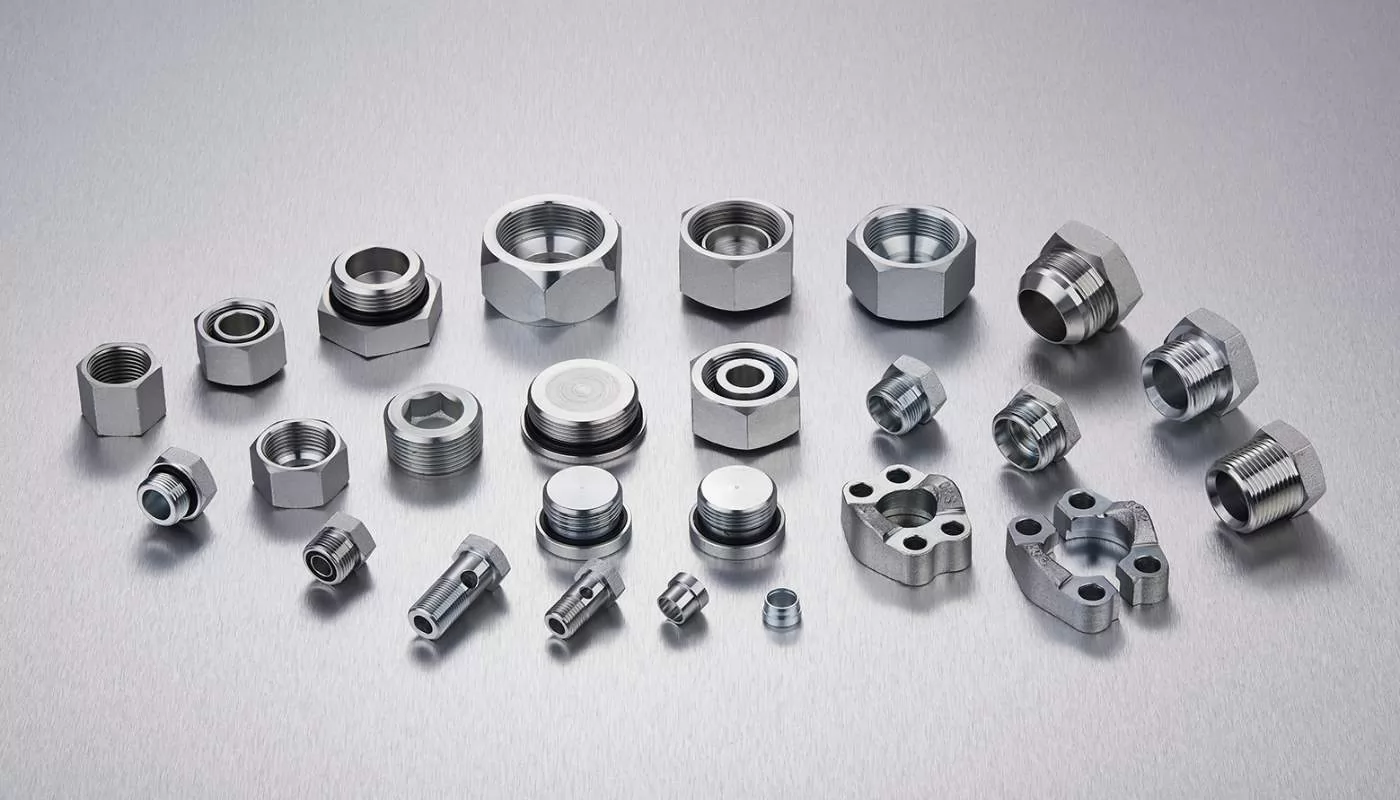
Order consolidation is worth asking about explicitly rather than assuming: whether a straight BSPP fitting, a 90° JIC swivel, an ORFS elbow and a flange half can travel through machining, plating and packing as one job on one document set. Ask which stages are in-house and which are subcontracted.
The hose fittings page states that the insert and the ferrule are machined as a matched pair for each hose construction, which is the right way round: the ferrule is selected by the hose, not by the port thread. Confirm the pairing for the series you actually crimp to.
The published pages establish three things. A single part page, such as the 22611 BSP female 60° cone fitting, carries a dimension table — part number, thread E, hose bore in DN, dash size, and the A, C and S2 dimensions — with a note that a spiral-hose variant of the same end is ordered under a different series number, and it states material, surface treatment and a salt-spray duration for the part. The 2024 catalogue is a downloadable PDF covering the range. Whether a drawing is supplied as a CAD model or a PDF is answered per part number, so if either is a condition of your order, ask for it with the part number.
Two things this page will not do. It will not quote an MOQ, lead time or price that has not been agreed against your part and quantity, because those are properties of the order rather than of the company. And it will not claim a certification on HGW’s behalf: if a certificate, test report, material grade or approval is a condition of your order, state it with the part number and it should be confirmed in writing before the quotation.
Request a Quote for Hydraulic Hose Fittings
The fastest route to a comparable quote is a specification, not an inquiry. What to send depends on what you are buying.
Standard fitting orders: part number, the thread specification for each end, quantity, and destination. If the part number is yours rather than the supplier’s, send the drawing or a sample as well, because a number alone does not define a seat.
Custom orders: a drawing or sample, the application and working pressure, material and plating, the hose series it will be crimped to, marking and packaging requirements, expected annual volume, and whether a first-article report is required before the balance of the order ships.
With those details a quotation is issued against a defined part instead of an assumption, and anything that cannot be met is raised before production rather than at goods-in. If you are still at sample stage, say so — a sample and a first-article report are a legitimate first order.
Need hydraulic hose fittings quoted against your specification?
Send HGW Hydraulic your drawing, part number, existing sample or application requirements for review.


-
2025 Shanghai Bauma Exhibition China International Construction Machinery ExhibitionUpdate on 2025-10-17
-
2025 Las Vegas International Mining ExhibitionUpdate on 2025-10-17
-
Leading the High-End and Empowering the World | Bauma China 2025, Hgw Successfully ConcludedUpdate on 2025-10-17
-
Hgw's Multi-field Hydraulic Products Appeared at the Exhibition丨MINEXPOUpdate on 2025-10-17
-
2025 PTC ASIAUpdate on 2025-10-17
-
Top 10 Leading Hydraulic Fitting Manufacturers List in the World [2026 Updated]Update on 2026-10-22
-
Why Choose Hydraulic Hose Fitting Manufacturers in China?Update on 2026-10-27
-
Top 10 Global Suppliers of Hydraulic Hose FittingsUpdate on 2025-03-04


