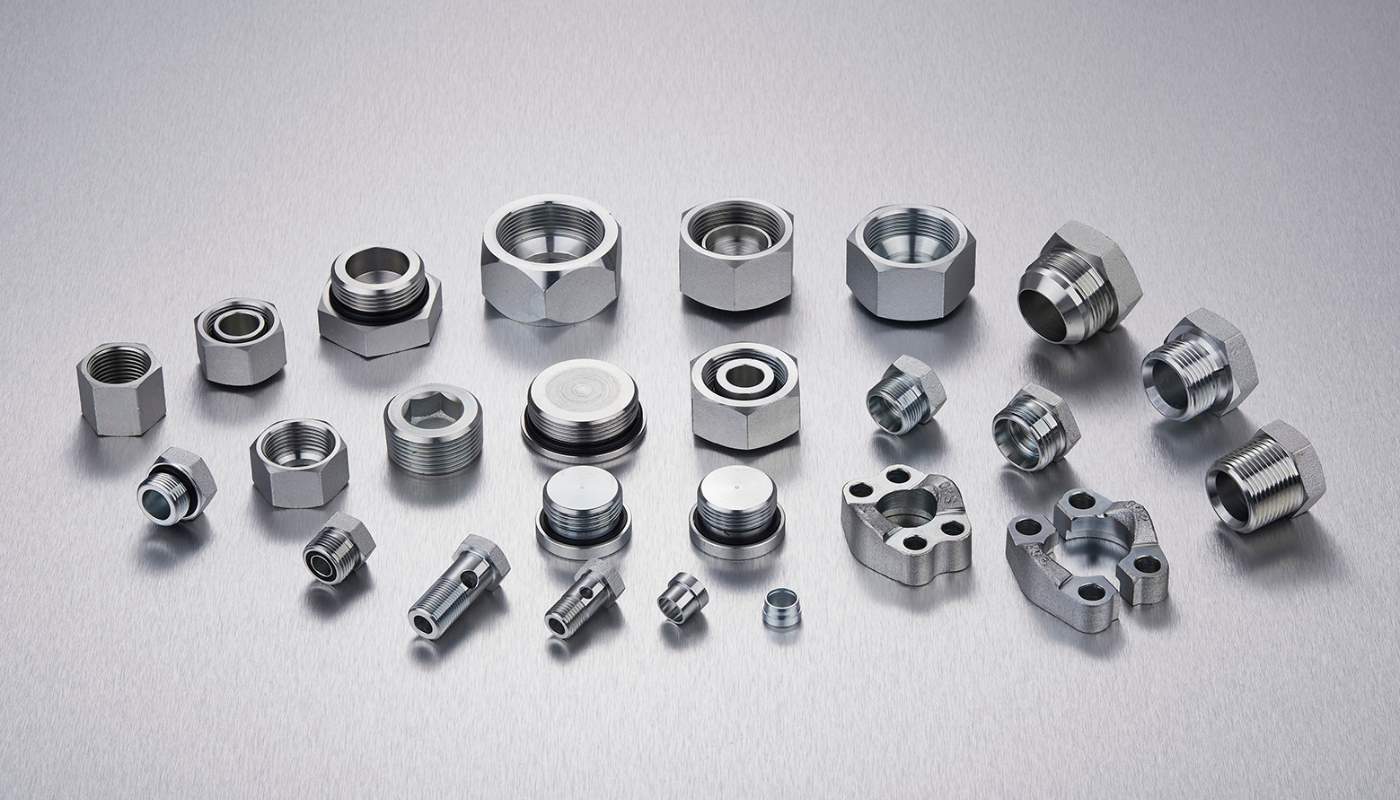
An adapter solves exactly one problem: two ports that do not share a thread. So the only useful specification is the pair — what is on each end, and what seals each end. Body shape, material and plating all follow from that. Below are the four configurations we machine, the sealing methods they use, and the thread pairings we cut most often, from G1/8 to G2.
Four Configurations Cover Almost Every Conversion
A straight male-to-male adapter joins two female ports. A male-to-female adapter is also a reducer, and is what you use when the sizes differ as well as the standards. A 45° or 90° elbow exists for the case where a straight body would foul the manifold or the hose bend radius. A run tee or branch tee splits one line into two without adding a second joint, which matters on return lines where every extra connection is a potential leak.
The part number already tells you the pair. 1BT4-SP is a BSPP male 60° seat on one end and a BSPT male on the other, in a 45° elbow body. Once you can read the prefix and the angle code, the catalog can be ordered from without a drawing.
G or R: The BSPP to BSPT Conversion People Get Wrong
BSPP uses a G thread — parallel, with the seal made on a 60° cone or under a bonded washer. BSPT uses an R thread — tapered, with the seal made by the threads deforming into each other. Both are called BSP and both are 55°, which is exactly why they get confused. A G male threaded into an R female will run in several turns and feel tight, but the cone never contacts anything and the taper never loads, so it weeps.
Converting between them needs a fitting that carries both seats: a BSPP male cone on one end and a BSPT male taper on the other, with sealant on the taper end only. Do not use PTFE tape on the cone end — it shifts the seat and can crack the female cone. If you are unsure which thread you are holding, the cone angle and the pitch settle it, as covered in our BSPP vs BSPT comparison.
What Actually Seals: One Rule, Six Methods
The thread holds; the seat seals. Once you accept that, every hydraulic connection becomes readable. A 60° cone or a 37° flare seals metal-to-metal at the nose. A flat face with an O-ring seals on an elastomer compressed against a machined face. A taper thread seals along the thread flank. A bonded washer seals under the hex. A spherical seat seals by line contact and tolerates a small misalignment.
The rule that follows: never mix two sealing methods in one joint, and never add sealant to a joint designed to seal metal-to-metal. Sealant on a 37° flare or a 60° cone changes the contact geometry and is a common cause of a slow weep that only appears when the oil is hot. The same logic explains what a hose connector is doing on the other end of the line.
Orientation, Wrench Flats and Bulkhead Mounts
An elbow has to end up pointing somewhere. If the thread is tapered, the only way to adjust the angle is to back it off, which destroys the seal — so tapered elbows are set once, with sealant, and left alone. If the thread is parallel with a cone or an O-ring, the body can be indexed freely and the nut tightened afterwards, which is why parallel-thread elbows are preferred where access is tight.
Wrench flats are listed as S1 and S2 in our tables and they are not decorative: an adjustable wrench on a 316L body rounds the flats and, worse, loads the seat. For bulkhead mounting, use a bulkhead adapter with a locknut rather than clamping the body — a clamped body distorts the bore and the O-ring groove. If the other end of the line needs a crimped hose fitting, keep the two decisions separate: the adapter converts the port, the fitting terminates the hose.
1BT4-SP BSPP Male 60° Seat × BSPT Male 45° Elbow — Standard Dimensions
|
Part No. |
Thread E (BSPP) |
Thread F (BSPT) |
A |
B |
S1 |
|
1BT4-02SP |
G1/8"×28 |
R1/8"×28 |
17 |
17 |
11 |
|
1BT4-04SP |
G1/4"×19 |
R1/4"×19 |
20.3 |
21 |
14 |
|
1BT4-06SP |
G3/8"×19 |
R3/8"×19 |
22 |
23 |
16 |
|
1BT4-08SP |
G1/2"×14 |
R1/2"×14 |
27 |
29.5 |
22 |
|
1BT4-10SP |
G5/8"×14 |
R1/2"×14 |
28.5 |
29.5 |
22 |
|
1BT4-12SP |
G3/4"×14 |
R3/4"×14 |
31 |
30.5 |
27 |
|
1BT4-16SP |
G1"×11 |
R1"×11 |
35 |
38 |
33 |
|
1BT4-20SP |
G1-1/4"×11 |
R1-1/4"×11 |
38.5 |
43 |
41 |
|
1BT4-24SP |
G1-1/2"×11 |
R1-1/2"×11 |
44 |
47.5 |
48 |
|
1BT4-32SP |
G2"×11 |
R2"×11 |
49.5 |
55.5 |
63 |
Dimensions in mm. A is the BSPP end length, B the BSPT end length, S1 the hex across flats.
Which Seal, and Whether It Takes Sealant
|
Seal type |
Thread |
Seals on |
Sealant |
|
60° cone |
BSPP / BSPT |
Cone face at the nose |
No |
|
37° flare |
JIC / SAE J514 |
Flare face, metal to metal |
No |
|
Flat face + O-ring |
SAE ORFS |
Elastomer against a flat face |
No |
|
Taper thread |
NPT / BSPT |
Thread flanks |
Yes |
|
Bonded washer |
BSPP / metric parallel |
Washer under the hex |
No |
One rule: a joint designed to seal metal-to-metal never gets sealant. It changes the contact geometry.
Frequently Asked Questions
Is a hose adapter the same as a hose connector?
In practice the terms overlap, which is why the same page has to serve both searches. Strictly, a connector joins two hoses or a hose to a port, while an adapter joins two different thread standards. If the two ends share a thread, it is a connector; if they do not, it is an adapter. Tell us the two threads and the distinction stops mattering.
Can I join BSPP directly to NPT?
Not with a single seal. BSPP is a parallel thread sealing on a 60° cone; NPT is a tapered thread sealing on its flanks. You need an adapter with a BSPP cone or flat face on one end and an NPT taper on the other, with sealant applied only to the NPT end. Forcing a BSPP male into an NPT female threads by less than a turn and will not seal.
Why does my adapter only leak when the oil is hot?
Almost always a sealant or seat problem rather than a torque problem. Sealant or tape on a cone or flare face shifts the metal-to-metal contact, and differential expansion between steel and the sealing compound opens a path once the joint reaches operating temperature. Clean both seats, remove all tape residue and re-make the joint dry on the cone side.
Do you make custom thread combinations?
Yes. We machine non-standard pairs, special angles and extended bodies from a drawing or a sample. Send the two thread specifications, the body angle and the material, and we will quote with a drawing for approval before production.
Why Choose HGW Conversion Adapters?
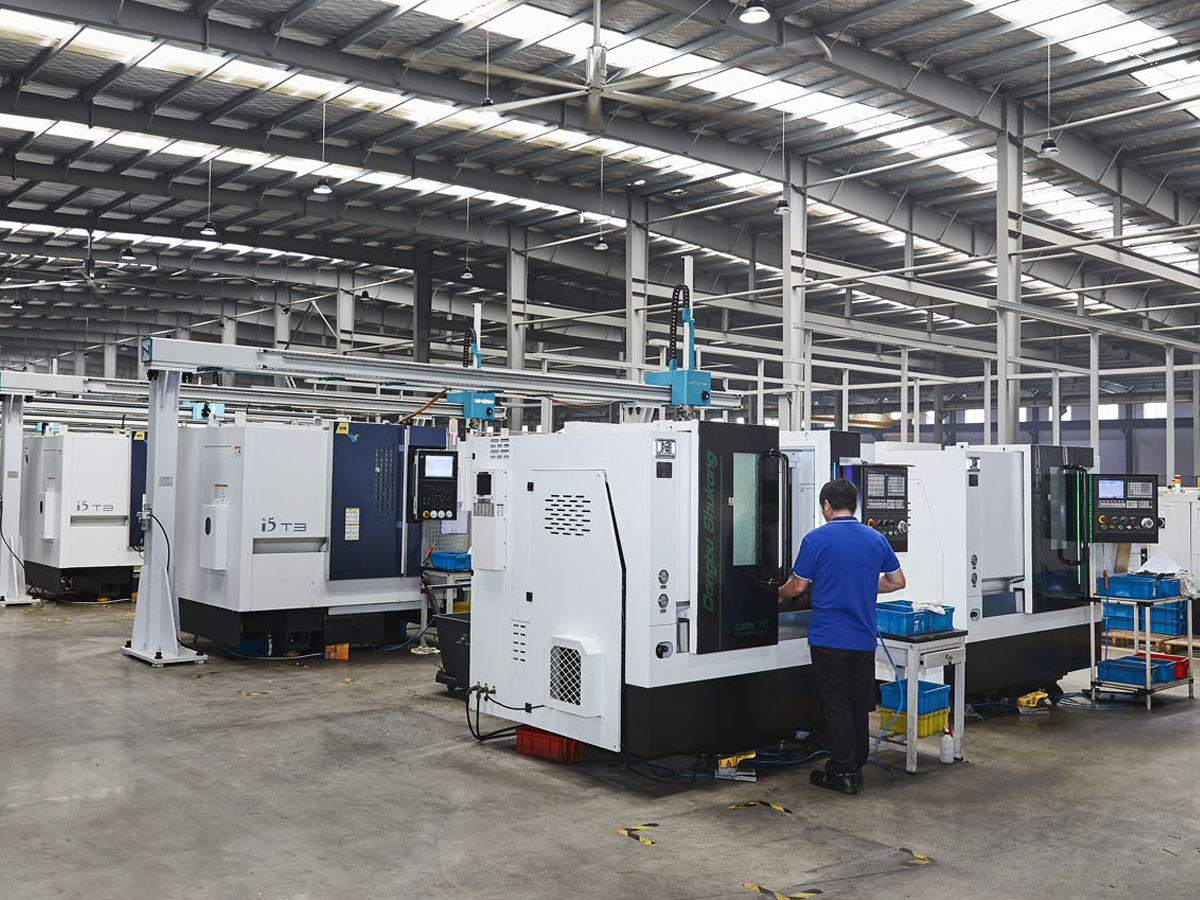
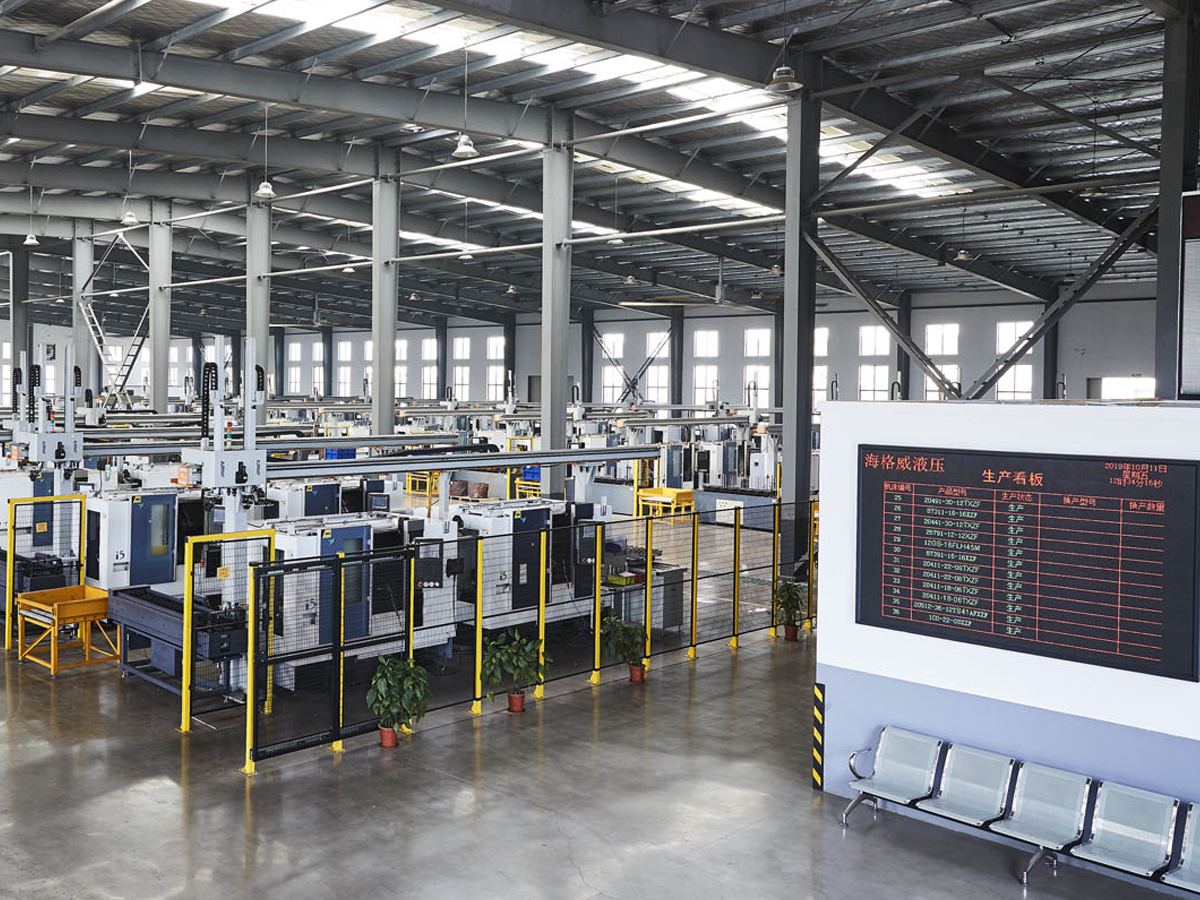
When it comes to conversion adapters, HGW Hydraulic stands out as an industry leader. With 28 years of expertise since 1996, we’ve perfected hydraulic solutions for engineering, mining, and shipbuilding applications. Our conversion adapters, crafted from high-grade stainless steel, meet ISO 14001:2015 standards, ensuring exceptional durability and resistance to pressure. Need NPT, JIC, or metric connections? We provide tailored options to seamlessly integrate into your system. Customers worldwide trust HGW for our precision manufacturing and reliable performance—making us the smart choice for long-lasting hydraulic fittings that keep your operations running smoothly.
How to Choose the Right Conversion Adapters?
Selecting the best conversion adapters doesn’t have to be complicated—HGW Hydraulic makes it simple with these key steps:
-
Identify Your Connection: Match your system with NPT, JIC, or metric adapters from our extensive range.
-
Factor in Environment: Our stainless steel adapters tackle high-pressure and corrosive conditions, perfect for mining or machinery.
-
Pick a Style: Whether straight, elbow, or custom, we design adapters to fit your unique setup.
-
Lean on Expertise: With 28 years and ISO 14001:2015 certification, we deliver quality you can count on. Let HGW guide you to the right conversion adapters—contact us today for a solution that works!