
Custom Hydraulic Fittings: A Complete Guide for OEMs and Buyers




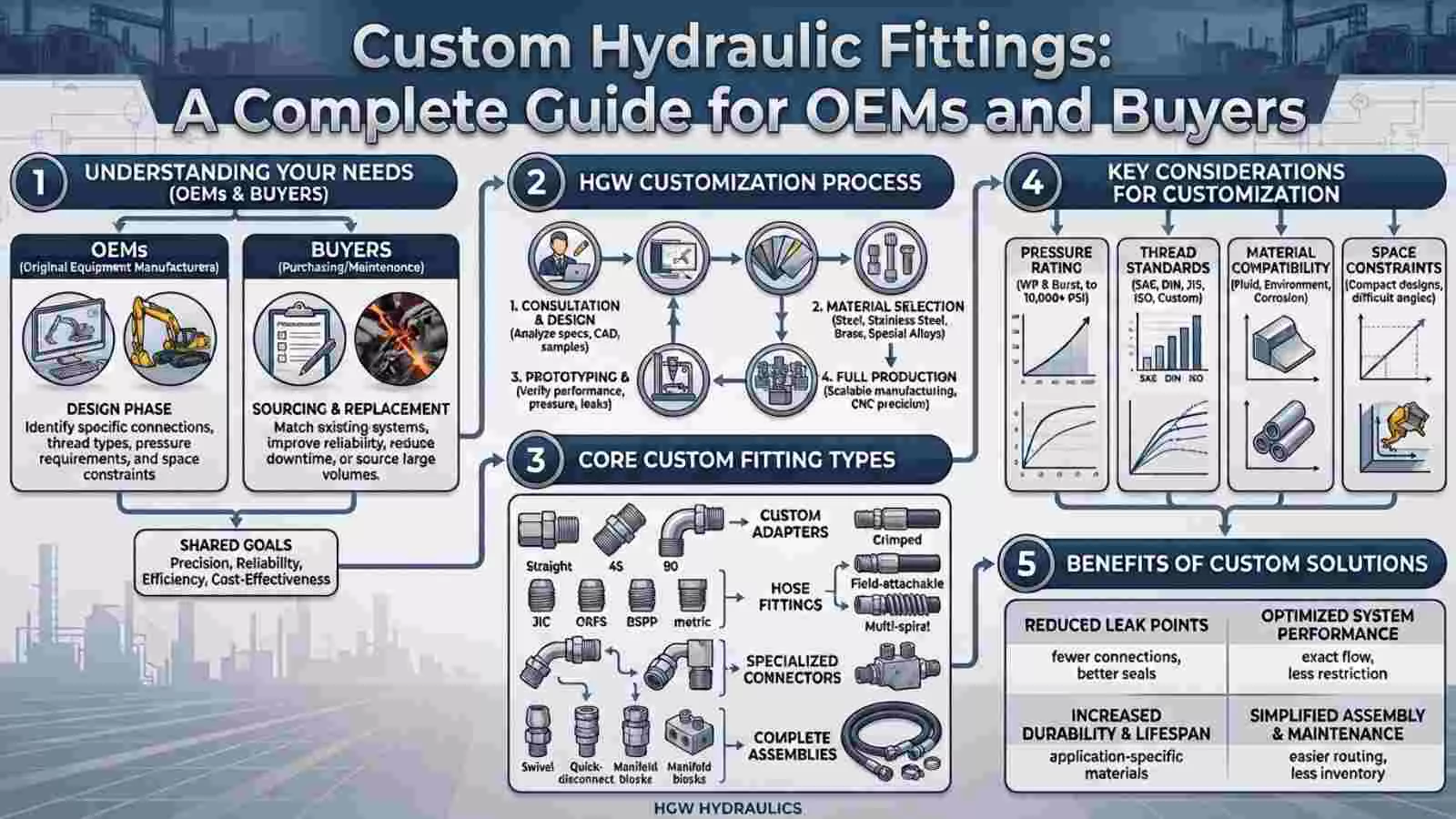
Standard hydraulic fittings work well for many applications, but OEM equipment and specialized hydraulic systems do not always fit standard catalog options. Unusual dimensions, limited installation space, different connection requirements, or specific operating conditions may require a more application-specific solution. This is where custom hydraulic fittings can provide a distinct advantage. Instead of adapting equipment around an existing component, a custom hydraulic fitting can be developed around the actual requirements of the hydraulic system, helping to simplify installation, reduce unnecessary adapters, and provide a superior fit for specialized OEM hydraulic assemblies.
Table of Contents
- What Are Custom Hydraulic Fittings?
- When Should You Use Custom Hydraulic Fittings?
- Standard vs. Custom Hydraulic Fittings
- What Can Be Customized in a Hydraulic Fitting?
- How to Specify a Custom Hydraulic Fitting
- How Are Custom Hydraulic Fittings Manufactured?
- Custom Hydraulic Fittings vs. Hydraulic Adapters
- How to Choose a Custom Hydraulic Fittings Manufacturer
- Common Mistakes When Ordering Custom Hydraulic Fittings
- Custom Hydraulic Fittings from HGW Hydraulics
- Frequently Asked Questions
- Conclusion & Quote Request
What Are Custom Hydraulic Fittings?
Custom hydraulic fittings are connection components manufactured according to application-specific requirements rather than selected entirely from a standard catalog.
The fitting may use a standard connection type while incorporating custom dimensions, geometry, angles, materials, or sealing features. In other cases, the complete fitting may be designed specifically for an OEM hydraulic assembly.
The purpose of customization is not simply to create a unique component. A suitable custom fitting should provide the required connection, fit, sealing, and operating performance while remaining practical to manufacture consistently.
Explore our comprehensive range of standard and specialized Hydraulic Fittings to learn more about our foundational product lineup.
When Should You Use Custom Hydraulic Fittings?
Custom fittings are not automatically better than standard components. If a standard fitting meets the application's requirements, it will often be the simpler and more economical option. Customization becomes more valuable when standard products create design or installation compromises.
Non-Standard Dimensions or Geometry
An OEM may require a specific overall length, diameter, angle, offset, port position, or internal passage that is not available from standard products. This is common in compact machinery where even a small dimensional difference can affect clearance or component alignment. A custom fitting allows these dimensions to be designed around the actual equipment instead of forcing the equipment to accommodate an unsuitable standard component.
Limited Installation Space
Hydraulic systems often have to operate within restricted spaces. Using several standard fittings and adapters may solve a connection problem, but it can also increase the installation envelope and add additional connection points. A custom fitting can sometimes combine functions into a more compact component, helping simplify hose routing and installation.
Different Connection Requirements
A hydraulic assembly may require different connection interfaces on opposite ends of the same fitting. For example, one side may need to connect to an existing hose while the other side must match a particular equipment port. A custom component can be designed around these requirements rather than relying on several standard adapters.
The important point is that connection selection involves more than nominal thread size. The connection type, mating component, sealing method, and dimensions all need to be compatible. Check out our detailed Hydraulic Fitting Standards Guide for in-depth specs.
Special Operating Conditions
Pressure, temperature, hydraulic fluid, vibration, and environmental exposure can all influence fitting selection. When a standard fitting does not provide the required combination of characteristics, a custom design may offer a more appropriate solution.
OEM Equipment
Custom hydraulic fittings are particularly relevant to OEM manufacturers that need a component to fit a proprietary machine or hydraulic assembly. Once a design is approved, the same specification can be used for repeat production, making consistency an important consideration when choosing a supplier.
Standard vs. Custom Hydraulic Fittings
The choice should be based on the complete application rather than unit price alone:
| Factor | Standard Fittings | Custom Fittings |
|---|---|---|
| Dimensions | Standardized | Application-specific |
| Availability | Usually faster | Requires production |
| Initial Cost | Generally lower | Usually higher |
| Design Flexibility | Limited | High |
| Special Geometry | Limited | Possible |
| OEM Integration | Depends on application | Highly suitable |
| Replacement | Usually easier | Requires controlled sourcing |
If a standard product already meets the required specifications, customization may add unnecessary cost and development time. If adapters, installation problems, or design compromises are involved, however, a custom fitting may provide better overall value.
Request a Custom Fitting Quote
What Can Be Customized in a Hydraulic Fitting?
Customization does not necessarily mean redesigning every feature. Depending on the project, only certain characteristics may need to change.
Connection and Thread
Custom fittings can be specified with the connection interfaces required by the application. Common hydraulic connection families include BSP, JIC, NPT, metric, ORFS, and other standards. The key is to identify the connection on each end, including its configuration and sealing method. For detailed information about individual standards, buyers should refer to our comprehensive HGW Hydraulic Fitting Standards Guide rather than relying on a general custom-fitting specification.
Dimensions and Geometry
Dimensions that may be customized include:
- Overall length and Body diameter
- Port depth and Bore size
- Thread length, Angle, and Offset
- Centerline dimensions
Body geometry can also be adapted for straight, angled, offset, or compact installation requirements.
Material and Surface Treatment
Material selection should consider mechanical requirements, corrosion exposure, hydraulic fluid compatibility, temperature, and expected service conditions. Surface treatment can also be specified according to the operating environment and durability requirements.
Sealing Configuration
A fitting's sealing performance depends on the complete connection, not just the thread. Depending on the design, sealing may involve an O-ring, gasket, cone, sealing surface, or another interface.
How to Specify a Custom Hydraulic Fitting
A clear technical specification helps reduce quotation errors, engineering revisions, and problems during sampling.
- Define the Application: Equipment type, hydraulic fluid, working pressure, temperature range, environment, vibration, and space limits.
- Define Connection Interfaces: Connection standard, thread size, male/female configuration, hose/tube connection, and sealing method.
- Confirm Critical Dimensions: Provide a 2D drawing or 3D CAD model detailing overall length, thread dimensions, bore, angle, and offset.
- Select Material and Finish: Match materials and surface treatments to pressure, temperature, and corrosion demands.
- Define Performance Requirements: Specify working pressure, test pressure, operating temperature, and leakage tolerances.
- Provide a Drawing or Sample: A clear reference drawing ensures controlled manufacturing and precise inspection.
How Are Custom Hydraulic Fittings Manufactured?
The exact production process depends on the fitting's design, material, quantity, and required tolerances. A typical custom project moves through several key stages:
- Engineering and Drawing Review: Resolving unclear dimensions, tolerances, or material specs before production.
- CNC Machining and Forming: Precision machining to maintain critical dimensions for repeat OEM projects.
- Thread and Sealing Features: Tight dimensional control on thread and sealing zones to ensure assembly integrity.
- Finishing and Cleaning: Proper deburring, surface treatment, and thorough cleaning prior to inspection.
- Inspection and Testing: Verifying dimensions, thread quality, surface finish, and pressure limits.
- Prototype Approval: Validating physical fit and installation with a sample batch before full-scale manufacturing.
Custom Hydraulic Fittings vs. Hydraulic Adapters
A custom fitting is not always necessary. In some cases, a standard conversion adapter can solve the problem faster and more economically.
When a Standard Adapter Is Enough
A standard adapter may be suitable when:
- Only thread conversion is required.
- Both connection interfaces are common.
- Available dimensions fit the installation easily without special geometry.
Check out our full range of HGW Conversion Adapters for quick thread conversion solutions.
When a Custom Fitting Is Better
Customization becomes more attractive when:
- Installation space is heavily restricted.
- Several adapters would otherwise be required, adding leak points.
- A special angle, offset, or direct OEM equipment integration is mandatory.
How to Choose a Custom Hydraulic Fittings Manufacturer
Choosing a supplier for a custom component requires more than comparing quotations. Key evaluation pillars include:
- Engineering Capability: Ability to interpret technical drawings and identify potential risks early.
- Manufacturing Capability: Modern machinery capable of maintaining high precision across batch runs.
- Quality Control: Strict raw material checks, dimensional inspections, and leakage testing.
- Prototype Support & Communication: Willingness to support sample iterations and maintain clear technical dialog.
Common Mistakes When Ordering Custom Hydraulic Fittings
- Specifying Only Thread Size: Ignoring connection type, sealing method, and material properties.
- Providing Incomplete Drawings: Leaving out tolerances, which leads to manufacturing misinterpretations.
- Ignoring Sealing Configurations: Ensuring thread fit but failing to match the mating sealing interface.
- Skipping Prototype Validation: Moving straight to mass production without fit testing.
- Comparing Suppliers Only by Unit Price: Overlooking risks like rework, downtime, and inconsistent quality.
Custom Hydraulic Fittings from HGW Hydraulics
HGW Hydraulics: Strategic Partner for Precision Fluid Power
Operating since 1996, HGW Hydraulics is a premier direct manufacturer of hydraulic fittings and adapters, operating 5 manufacturing bases with over 400 employees and 1,000+ advanced CNC machines.
HGW's comprehensive catalog encompasses Hydraulic Fittings, Conversion Adapters, O-ring face seal fittings, flange fittings, and quick couplers across BSP, metric, JIC, NPT, and ORB configurations. With dedicated R&D and strict quality assurance, HGW is engineered to turn your complex custom fitting designs into high-performance realities.
Inquire About Custom Fittings Now
Frequently Asked Questions
What are custom hydraulic fittings?
Custom hydraulic fittings are fittings manufactured according to application-specific requirements, including tailored dimensions, geometry, connection interfaces, materials, or sealing configurations.
When should I choose custom fittings instead of standard fittings?
Choose custom fittings when standard catalog components cannot accommodate space restrictions, special routing angles, or unique equipment interfaces.
What information is needed to manufacture a custom hydraulic fitting?
Provide connection standards, dimensions, materials, pressure/temperature ranges, fluid type, quantity, and a 2D/3D CAD drawing or physical sample.
Can custom hydraulic fittings be made from a sample?
Yes, physical samples serve as an excellent starting reference, though critical dimensions and tolerances should still be formally documented prior to production.
How long does custom hydraulic fitting production take?
Lead times vary based on design complexity, tooling, material availability, and prototyping steps. Specific timelines are confirmed during the quotation phase.
Conclusion & Quote Request
Selecting the right custom hydraulic fittings manufacturer is vital for achieving optimal machine performance, leak-free operation, and efficient OEM equipment integration. By carefully defining your application parameters, selecting robust materials, and partnering with an experienced direct manufacturer like HGW Hydraulics, you ensure long-term durability and lower total operational costs.
Need Custom Hydraulic Fittings for Your Application?
The best custom fitting starts with clear technical requirements. Send HGW Hydraulics your drawing, CAD file, existing sample, or application specifications for review. Our team will evaluate your requirements and deliver a tailored solution for your OEM or industrial hydraulic setup.


-
2025 Shanghai Bauma Exhibition China International Construction Machinery ExhibitionUpdate on 2025-10-17
-
2025 Las Vegas International Mining ExhibitionUpdate on 2025-10-17
-
Leading the High-End and Empowering the World | Bauma China 2025, Hgw Successfully ConcludedUpdate on 2025-10-17
-
Hgw's Multi-field Hydraulic Products Appeared at the Exhibition丨MINEXPOUpdate on 2025-10-17
-
2025 PTC ASIAUpdate on 2025-10-17
-
Top 10 Leading Hydraulic Fitting Manufacturers List in the World [2026 Updated]Update on 2026-05-17
-
Top 10 Global Suppliers of Hydraulic Hose FittingsUpdate on 2025-03-04
-
HGW's O-Ring Face Seal Fittings(ORFS): From Core to Best UseUpdate on 2025-03-08


