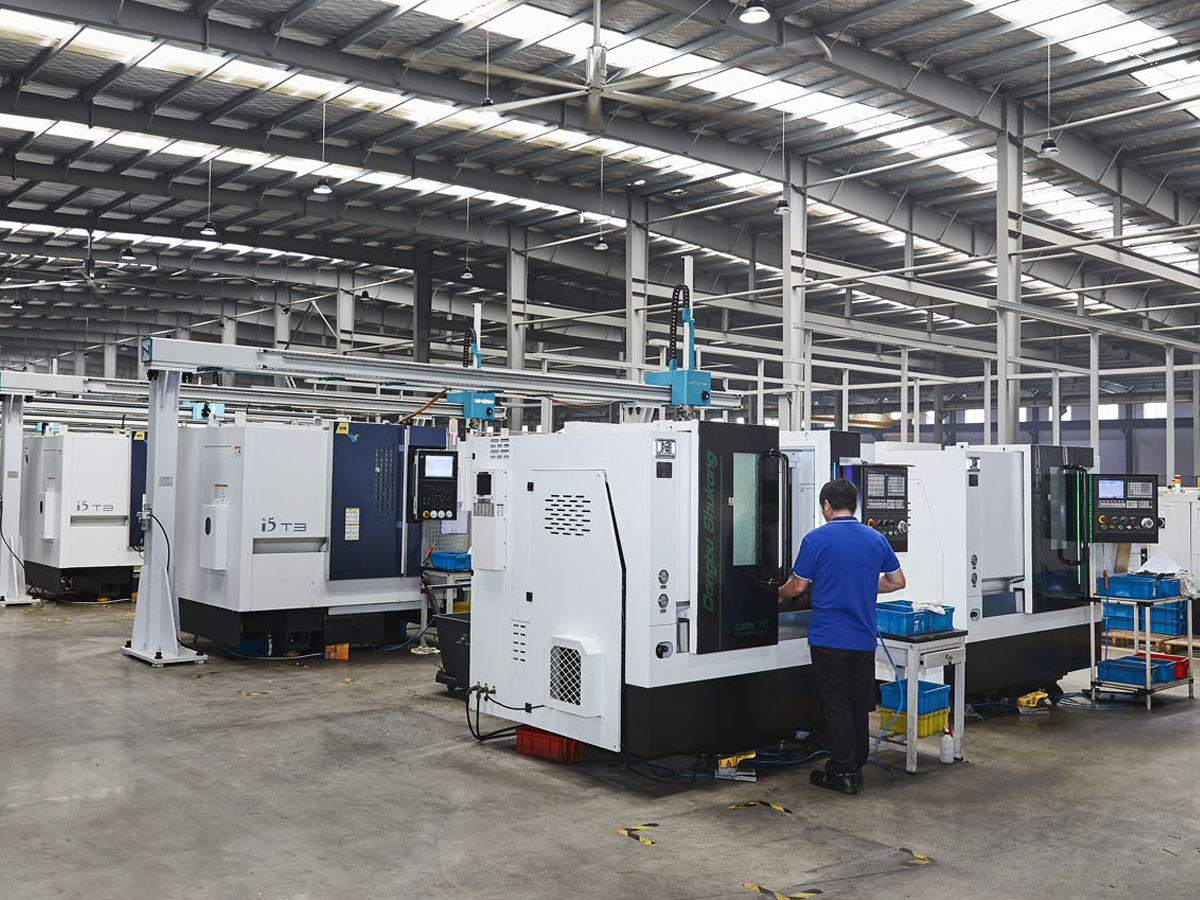
A hose assembly fails at the fitting far more often than in the hose itself. We machine the insert and the ferrule as a matched pair for each hose construction, so the crimp compresses the cover and the wire reinforcement by a controlled amount instead of crushing the bore. Below are the families we produce — BSPP and BSPT 60° cone, JIC 37° flare, NPT/NPTF, SAE ORFS and DIN 24° metric — from DN 5 to DN 50, in carbon steel with trivalent zinc or 316L stainless.
What a Crimped Hose Fitting Is Made Of
Three parts do three different jobs. The insert — the stem — sits inside the hose bore and carries the fluid; its barbs or grooves grip the inner tube so the assembly resists pull-off. The ferrule is crimped from outside and compresses the cover, the wire reinforcement and the tube onto that insert. The nut or swivel at the other end is what the mating port sees, and it holds the seat that actually seals.
Because the crimp is a metal-to-rubber-to-metal stack, the ferrule and the insert have to come from the same series. A ferrule sized for a two-wire braid will not develop enough radial force on a four-spiral hose, and a ferrule designed for a skived hose will cut into a no-skive cover. This is why mixed-brand assemblies tend to weep at the crimp rather than at the thread.
Five Thread Standards and Where Each One Belongs
BSPP uses a G thread — parallel, sealing on a 60° cone at the nose. BSPT uses an R thread — tapered, so it seals on the threads themselves and normally needs a sealant. JIC to SAE J514 seals on a 37° flare with metal-to-metal contact, which is why it survives high pressure and vibration without an elastomer. NPT is also tapered and, like BSPT, depends on thread deformation plus sealant. SAE ORFS seals on a flat face with an O-ring, so torque does not control the seal.
Mixing them is the most common cause of a leak that cannot be found. A BSPP male will start into a BSPT female and feel tight, but the cones never meet. If you are not certain what is on the port, measure the thread pitch and the cone angle first — our guide to identifying BSP fittings walks through both measurements with a caliper.
Matching the Fitting to the Hose, Not to the Port
The port tells you which thread you need. The hose tells you which insert and ferrule you need — and the two decisions are independent. A dash size is the hose bore in sixteenths of an inch: dash 08 is 1/2 in, or DN 12. The same dash 08 body exists in every thread family we make, so a JIC 08 and a BSPP 08 share a hose end and differ only at the port end.
Hose construction decides the ferrule. Braided 100R1 and 100R2 normally use a two-piece ferrule without skiving on modern covers. Spiral 4SP and 4SH need a longer ferrule with more crimp length to hold four or six wire layers. Suction and return lines with R13 or R15 need a ferrule built for the much thicker cover. If you are buying fittings for an existing hose, quote the hose print — series, bore and cover type — rather than the old fitting alone. The full range with dash and DN equivalents is in our fitting catalog.
Crimp Diameter, Insertion Depth and Four Ways an Assembly Fails
The crimp diameter comes from the crimper setting table for that hose and ferrule combination — never from measuring an old assembly, because the cover compresses permanently and the reading will be wrong. Two checks before the crimp: mark the insertion depth on the cover so you can see the hose has bottomed in the insert, and confirm the ferrule series matches the hose series printed on the layline.
The four failures we see most often are a ferrule from the wrong series, insufficient insertion so the hose pulls out under pressure, an over-crimped ferrule that cuts the inner tube, and a dry assembly where the hose was pushed in without lubricant and shaved the tube on the barbs. None of them show up in a static pressure test — they show up as a weep three weeks into service. Where an assembly has to change thread standard at one end, a hose fitting plus a conversion adapter is usually cheaper than a special crimp fitting.
22611 BSPP Female 60° Cone — Standard Dimensions
|
Part No. |
Thread E |
Hose bore DN |
Dash |
A |
C |
S2 |
|
22611-02-03 |
G1/8"×28 |
5 |
03 |
15 |
5.5 |
14 |
|
22611-04-04 |
G1/4"×19 |
6 |
04 |
18 |
5.5 |
19 |
|
22611-04-06 |
G1/4"×19 |
10 |
06 |
18 |
5.5 |
19 |
|
22611-06-06 |
G3/8"×19 |
10 |
06 |
19.5 |
6.3 |
22 |
|
22611-08-08 |
G1/2"×14 |
12 |
08 |
21.5 |
7.5 |
27 |
|
22611-10-10 |
G5/8"×14 |
16 |
10 |
23.5 |
9.5 |
30 |
|
22611-12-12 |
G3/4"×14 |
20 |
12 |
24 |
10.9 |
32 |
|
22611-16-16 |
G1"×11 |
25 |
16 |
27 |
11.7 |
41 |
|
22611-20-20T |
G1-1/4"×11 |
32 |
20 |
27.5 |
11 |
50 |
|
22611-24-24 |
G1-1/2"×11 |
38 |
24 |
32 |
13 |
55 |
|
22611-32-32W |
G2"×11 |
50 |
32 |
31.9 |
16 |
70 |
Dimensions in mm. Full range, inch equivalents and drawing files are in the catalog.
Thread Standards at a Glance
|
Standard |
Thread form |
What seals |
Where it is used |
|
BSPP (G) |
Parallel, 55° |
60° cone at the nose, or a bonded washer |
General hydraulic and pneumatic ports, Europe and Asia |
|
BSPT (R) |
Tapered, 55° |
Thread flanks, plus sealant |
Older European ports, water and air lines |
|
JIC (SAE J514) |
Parallel, 37° flare |
Metal-to-metal on the 37° cone |
High-pressure hydraulic, North America |
|
NPT / NPTF |
Tapered, 60° |
Thread flanks, plus sealant |
North American pipe ports, joints rarely opened |
|
SAE ORFS |
Parallel, flat face |
O-ring compressed against a metal stop |
Mobile hydraulic, vibration-prone lines |
|
Metric DIN 24° |
Parallel, 24° cone |
Metal-to-metal, with or without O-ring |
DIN and ISO hydraulic circuits |
Sealing method decides compatibility, not the thread angle. Two standards can share 55° and still not seal together.
Frequently Asked Questions
What is the difference between BSPP and BSPT hose fittings?
BSPP has a parallel G thread and seals on a 60° cone at the nose; BSPT has a tapered R thread and seals on the threads. They share the same 55° thread angle, which is why they are so often confused, but a BSPP male will not seal in a BSPT female without an adapter that carries both seats.
How do I convert a hose dash size to DN?
A dash size is the hose bore in sixteenths of an inch. Dash 04 is 1/4 in (DN 6), dash 06 is 3/8 in (DN 10), dash 08 is 1/2 in (DN 12), dash 12 is 3/4 in (DN 20), dash 16 is 1 in (DN 25) and dash 32 is 2 in (DN 50). The two numbering systems are close but not identical, so always state which one you are quoting.
Can a ferrule or a crimped fitting be reused?
No. Once crimped, the ferrule has taken a permanent set and the hose cover under it is deformed. Re-crimping the same ferrule will not develop the same radial force, and cutting the hose back to a fresh section requires a new ferrule as well. The insert can sometimes be reused if the barbs are undamaged, but not the ferrule.
Do you make fittings for 4SH and R15 hose?
Yes. Spiral hose uses a longer ferrule with a higher crimp length than braided hose, and the insert differs as well. Tell us the hose series and brand — 4SP, 4SH, R12, R13 or R15 — because crimp dimensions are hose-specific, not fitting-specific.